Why D2C Brands Are Ditching SEO Agencies for AI | Jarbug
Why Your D2C Brand Doesn't Need an SEO Agency Anymore
Here's the uncomfortable truth: most D2C brands are overpaying for SEO results they could automate.
Traditional SEO agencies were designed for a different era when search moved slowly, when manual audits made sense, and when waiting weeks for page optimizations was acceptable. But if you're running a D2C brand in 2026, you already know that model doesn't work anymore.
Your customers are searching for your products right now. Not next quarter. Not after the monthly strategy call. Right now.
The Agency Model Was Built for a Slower Internet
SEO agencies operate on human timelines. That means:
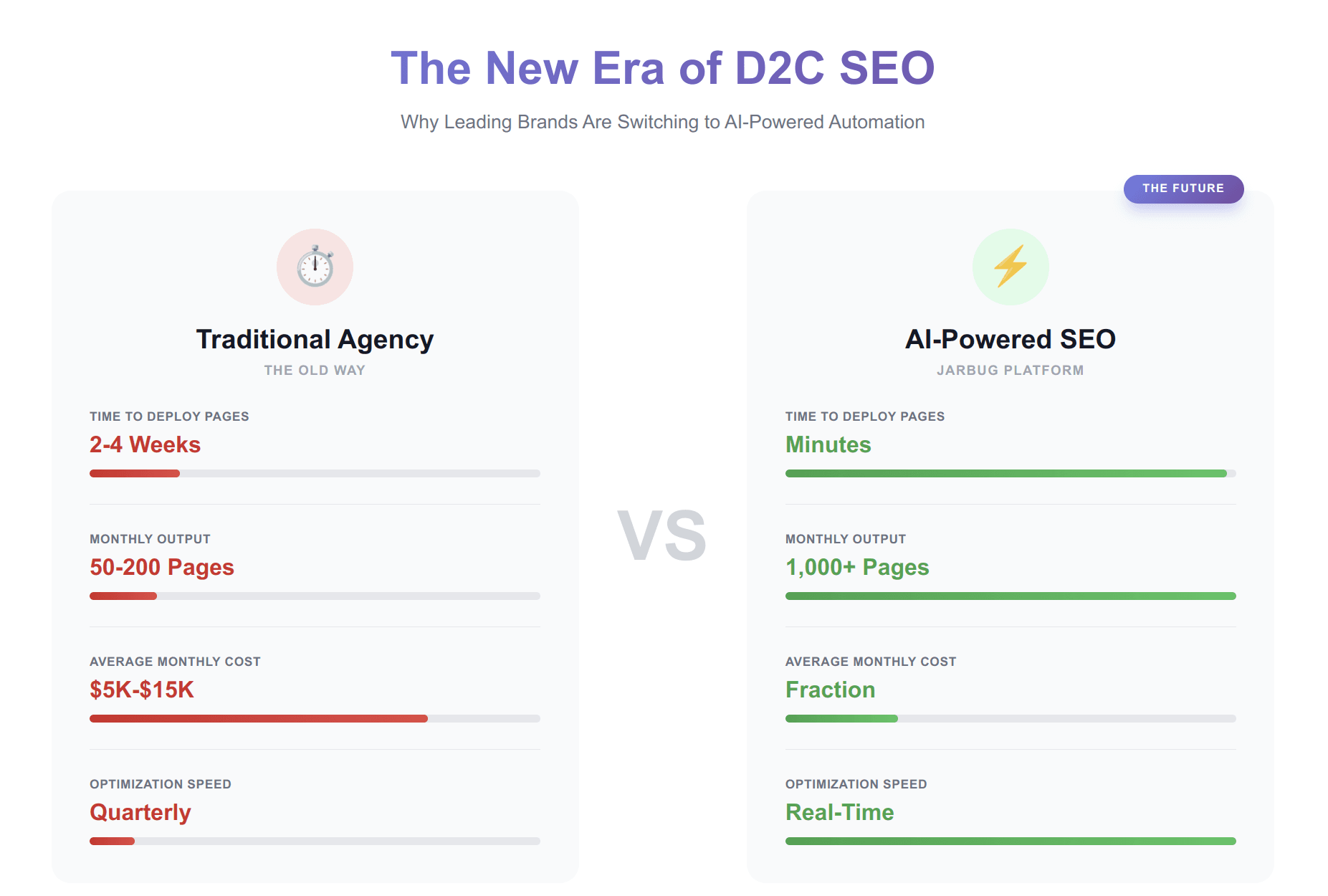
- Waiting 2-4 weeks just to get new pages published
- Paying $3,000-$15,000/month for work that rarely scales with your catalog
- Sitting through endless meetings to explain what you need (again)
- Getting vague monthly reports that don't clearly tie to revenue
Meanwhile, search intent is shifting daily. Your competitors are launching new products. Amazon is outranking you for your own brand terms. And you're stuck waiting for someone to find time in their queue to fix a metadata issue.
It's not that agencies are bad at SEO. It's that the traditional agency structure no matter how talented the team simply can't operate at the speed modern D2C brands need.
What AI-Powered SEO Actually Means for D2C Brands
This isn't about replacing one tool with another. It's about fundamentally changing how SEO happens for your brand.
Platforms like Jarbug don't just analyze what's wrong with your SEO they actually fix it. Automatically. At scale.
Here's what that looks like in practice:
Instead of manually researching keywords for weeks, AI identifies thousands of high-intent, long-tail searches your customers are already using—the ones agencies miss because they're too time-consuming to chase.
Instead of waiting for a copywriter to create landing pages, the system generates SEO-optimized pages that match search intent, complete with metadata and internal linking at machine speed.
Instead of quarterly strategy refreshes, the platform monitors performance continuously and adapts pages when search behavior changes or competitors make moves.
What once required an entire SEO team for keyword research, content creation, technical optimization, performance monitoring, now happens automatically in the background while you focus on building your brand.
The Speed Gap Is Real (And It's Costing You Revenue)
Let's be honest: agencies work in monthly cycles because that's how their business model works. Discovery in month one. Strategy in month two. Implementation in month three. Report. Repeat.
But here's what's happening while you're in that cycle:
- Seasonal trends come and go before you can capture them
- New product launches miss their SEO window
- Competitors rank for keywords you should own
- High-intent shoppers find someone else
AI doesn't have approval chains or capacity constraints. When a keyword opportunity emerges, it gets captured. When a page underperforms, it gets optimized. When search intent shifts, pages adapt.
This isn't just faster and it's a fundamentally different approach to organic growth.
The Math That Makes Agencies Nervous
Let's talk about what you're actually paying for with a traditional SEO agency:
A mid-tier agency charges $5,000-$10,000/month. Over a year, that's $60,000-$120,000. For that investment, you might get 50-200 optimized pages, some technical fixes, and monthly reporting.
Now compare that to AI-powered SEO: the same investment can generate thousands of high-intent pages, optimize your entire site's internal linking structure, and continuously improve performance based on real-time data without the overhead of meetings, revisions, or waiting for capacity.
For D2C brands with hundreds or thousands of SKUs, this difference isn't incremental. It's exponential.
But Can AI Actually Rank Pages?
This is the question every founder asks, and it's the right one.
Here's the reality: Google doesn't care whether a human or an AI created your page. Google cares about relevance, intent matching, and user experience.
AI-powered platforms like Jarbug excel at exactly these things. They analyze what's actually ranking for specific searches, understand the patterns, and create pages that match or beat what's already working. They structure content properly, optimize metadata correctly, and build internal linking that strengthens your entire site.
The results speak for themselves. D2C brands using Jarbug are seeing 90-200% traffic increases, often outranking major marketplaces for long-tail product searches.
Who Should Make the Switch
AI-powered SEO isn't for everyone. If you have 10 products and low search volume, you probably don't need it.
But if you're a D2C brand with:
- A growing product catalog that needs continuous SEO coverage
- High customer acquisition costs eating into margins
- Frustration with slow agency timelines
- Products people are actually searching for (but not finding you)
Then you're exactly who this technology was built for.
The brands winning with AI SEO aren't necessarily the biggest they're the ones who recognized that organic search is too important to be bottlenecked by human-speed processes.
The Compounding Advantage
Here's what most people miss about AI-powered SEO: it doesn't just replace agency work it creates advantages agencies literally cannot compete with.
When you can deploy thousands of optimized pages in the time it takes an agency to create ten, you don't just capture more keywords. You create a network effect where each page strengthens the others through intelligent internal linking.
When you can respond to search trends in real-time instead of quarterly, you don't just move faster you capture demand windows your competitors miss entirely.
When your SEO system learns and improves automatically, you're not just saving time, you're building a compounding asset that gets stronger while your competitors are still scheduling their next strategy call.
Frequently Asked Questions
Can AI really handle SEO for a D2C brand with thousands of products?
Yes, in fact, that's exactly where AI shines brightest. The more products you have, the more impossible it becomes for agencies to give each one proper SEO attention. AI platforms like Jarbug are built specifically to handle large catalogs, creating optimized pages for every product variant and long-tail keyword opportunity.
Will Google penalize AI-generated content?
Google's guidance is clear: they don't penalize content based on how it's created. They penalize low-quality, spammy content regardless of source. AI platforms that focus on relevance, intent matching, and proper optimization follow the same best practices that manual SEO does just at a scale and speed humans can't match.
How is this different from using ChatGPT to write product descriptions?
Completely different. Generic AI tools create generic content. Purpose-built SEO platforms like Jarbug analyze actual search data, study what's ranking, understand your product catalog, optimize technical elements, and build strategic internal linking then continuously monitor and improve performance. It's the difference between a smart assistant and a complete SEO infrastructure.
What happens to the pages if I stop using the platform?
That depends on the platform, but typically the pages remain live on your site. However, you lose the continuous optimization, performance monitoring, and adaptation to changing search behavior which is where much of the long-term value comes from.
How quickly can I expect to see results?
Most D2C brands see measurable traffic increases within 4-8 weeks as pages get indexed and start ranking. Unlike agency SEO where you wait months for implementation to even begin, AI platforms can start deploying optimized pages immediately. The advantage compounds over time as more pages rank and the internal linking network strengthens.